| Author |
[Modern View]
|
| 55 50 Ron
01-23-2013 17:35:15
209.131.224.57
|
Installed a new wiring harness on a Super MTA that had been converted to 12 volts negative ground.The diode to pin 1 on the alternator had a 39 ohm, 5W resistor in series in the old harness. What is the purpose of this resistor? I haven't seen one like this before. Am wondering if I should put the resistor in with the new harness? |
|
|
| oldtanker
01-25-2013 08:27:57
66.228.255.239
|
|
Re: alternator diode question in reply to 55 50 Ron, 01-23-2013 17:35:15
|
|
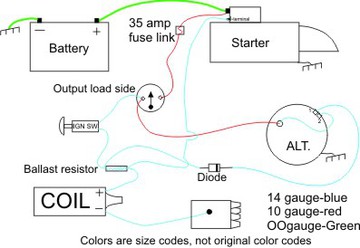
| Ron, you need the diode or light bulb to keep the alternator from back feeding the ignition system as others have posted.
The picture shows how to just wire a GM alternator. That wiring will not change with a new harness.
Rick |
|
|
| Moondoggie
01-25-2013 07:56:29
50.50.164.26
|
|
Re: alternator diode question in reply to 55 50 Ron, 01-23-2013 17:35:15
|
|
| Ah! So that"s why my 340 runs on after shutoff, for a few seconds. I"ve wired the diode in series, but not the resistor. Anyone care to draw a short wiring diagram? Learn something new each day. Thanks! |
|
|
| Janicholson
01-25-2013 15:30:06
74.60.94.18
|
|
Re: alternator diode question in reply to Moondoggie, 01-25-2013 07:56:29
|
|
|  This should help. The Starter is from a large frame but your relay should be similar. Both should not be necessary if the diode is placed with the band end as shown. Jim |
|
|
| merlynr
01-25-2013 08:12:41
166.137.101.177
|
|
Re: alternator diode question in reply to Moondoggie, 01-25-2013 07:56:29
|
|
| Google " bob melville" for drawings.
I converted my H and used a Chrysler voltage dropping resistor to keep the 6v coil and dizzy the same. Just reverse the leads on the coil because It's now 12v neg gnd. |
|
|
| oldtanker
01-25-2013 08:24:28
66.228.255.239
|
|
Re: alternator diode question in reply to merlynr, 01-25-2013 08:12:41
|
|
| Quoting Removed, click Modern View to see
The only thing needed to get rid of the risistor is a 12 volt coil. The points and condenser will be just fine. Dizzy stays the same. Only reason I kept the 6 volt coil on my M is I had the resistor and was low on funds at the time. Going with a 12 volt coil next tuneup.
Rick |
|
|
| merlynr
01-25-2013 14:27:49
166.137.101.153
|
|
Re: alternator diode question in reply to oldtanker, 01-25-2013 08:24:28
|
|
| The voltage dropping resistor is a lot cheaper than the 12 volt coil,but I also thought that the condenser in the dizzy would need changed. |
|
|
| oldtanker
01-25-2013 19:37:33
66.228.255.239
|
|
Re: alternator diode question in reply to merlynr, 01-25-2013 14:27:49
|
|
| Quoting Removed, click Modern View to see
It is cheaper but I'm a student of the "keep it simple" school. Taking the resistor out just eleminates one more thing that could go wrong. 12 volt coil really isn't that expensive. Last one I got was around 25 bucks.
Rick |
|
|
| Janicholson
01-25-2013 17:05:00
74.60.94.18
|
|
Re: alternator diode question in reply to merlynr, 01-25-2013 14:27:49
|
|
| Not needed, they are rated in the area of 400 volts, so 6 or 12 is not a problem. Jim |
|
|
| Indiana Ken
01-25-2013 06:11:52
66.249.232.131
|
|
Re: alternator diode question in reply to 55 50 Ron, 01-23-2013 17:35:15
|
|
| [quote="Owen Aaland"](quoted from post at 03:39:05 01/25/13)
"Actually this set up might be the best of both worlds.
The resistor will provide protection in case the battery to alternator wire becomes an open circuit which would cause the alternator output to all be on the #1 terminal circuit. The diode would provide a low resistance path to allow for a lower start up speed for the alternator".
I am not following this: How are you connecting the diode and the resistor?
My understanding would be - if connected in series the diode cannot provide a low resistance path and if connected in parallel the resistor cannot limit current. |
|
|
| John T
01-24-2013 06:20:18
71.52.103.159
|
|
Re: alternator diode question in reply to 55 50 Ron, 01-23-2013 17:35:15
|
|
| | Similar to the other gents, I use a 10 ohm safety current limiting voltage dropping resistor in the alternators external excitation circuit so the engine doesnt continue to run (via alternator backfeeding the coil) when the IGN switch is turned off. (talking about the GM 10SI 3 wire family of alternators that use external initial excitation voltage to start charging) A didoe serves the same purpose (has a 0.6 voltage drop) but doesnt provide the small degree of current limiting like a resistor does, which is why I use a resistor instead of a diode. For another double duty method, you can instead use a small "incandescent" NOT LED indicator light which provides current limiting to prevent run on plus serves as an idiot light. I think it was Bob M who noted you might even place a resistor in paralell with the idiot light so the alternator still excites even if the light were to burn out... John T |
|
|
| Owen Aaland
01-25-2013 02:39:05
216.47.34.216
|
|
Re: alternator diode question in reply to John T, 01-24-2013 06:20:18
|
|
| Quoting Removed, click Modern View to see
Actually this set up might be the best of both worlds.
The resistor will provide protection in case the battery to alternator wire becomes an open circuit which would cause the alternator output to all be on the #1 terminal circuit. The diode would provide a low resistance path to allow for a lower start up speed for the alternator. |
|
|
| Owen Aaland
01-26-2013 02:01:00
216.47.32.228
|
|
Re: alternator diode question in reply to Owen Aaland, 01-25-2013 02:39:05
|
|
| [quote="Indiana Ken"](quoted from post at 10:11:52 01/25/13) Quoting Removed, click Modern View to see
It is basically a solution in search of a problem that you are not likely to ever see. It really only applies if the alternator wire on the #2 terminal is connected remotely such as at the starter solenoid instead of the alternator output terminal. Connected remotely gives better control over the battery voltage than having it connected at the alternator.
Connect them in parallel.
When starting the diode will provide low resistance to energize the alternator. It will also prevent any current from flowing back to the switch which ensures that the switch can control the power to the coil.
The problem with having only a diode in the circuit to energize the alternator is if the wire between the alternator output and the battery should become open all the current would be fed through the #1 terminal back to the switch. With no path back to the sensing wire the alternator voltage will rise until it destroys the alternator. The resistor allows some of the current to flow back through the circuit so the sensing wire can still control the voltage but limit the current to prevent over loading the circuit. |
|
|
| Super-H-Mike
01-24-2013 06:48:00
76.164.147.173
|
|
Re: alternator diode question in reply to John T, 01-24-2013 06:20:18
|
|
| I agree, a small bulb like a 194 is simple and cheap plus it is visual. I tuck mine in the hood space where the steering goes through,you can see it from the seat, but doesnt show otherwise and protected from the weather. |
|
|
| Janicholson
01-23-2013 18:27:33
74.60.94.18
|
|
Re: alternator diode question in reply to 55 50 Ron, 01-23-2013 17:35:15
|
|
| The resistor is to prevent substantial current from flowing into the alternator from the ignition in the case that the alternator's internal regulator shorts out. It is a bit redundant in that the resistor alone will work to allow excitation. I have not seen any (nor heard of any) shorted to ground regulators that cause the issue above, so I don't recommend te use of both. But I have no issue with a marker lamp, diode, or resistor at or above 10 ohms being used to limit back feeding the ignition. Jim |
|
|
| hayfarmer
01-23-2013 17:40:49
71.80.194.62
|
|
Re: alternator diode question in reply to 55 50 Ron, 01-23-2013 17:35:15
|
|
| purpose of diode is so you can shut tractor off. Without diode or resister it will backfeed and keep running. I thought usually just diod or resister were used, not both. Perhaps reisster did not stop problem so they put diod in also. |
|
|